Колёса для наших бусов (T2 и T3) |
||||||||||||||||||||||||
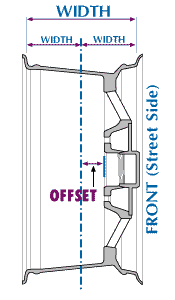
Вступление На всех VW Транспортер с 1971 по 1992 год использовались в основном одни и те же шины и колесные диски. Таким образом, следующая информация относится ко всем T2 бусам (с дисковыми тормозами) и T3 бусам. В США эти модели ласково называют Bay-window и Vanagons (кирпич). О дисках: Большинство бусов продавались со стандартными стальными дисками. Размер этих дисков был 5.5J x 14 с отверстиями под болты 5 x 112. Это говорит нам о следующем:
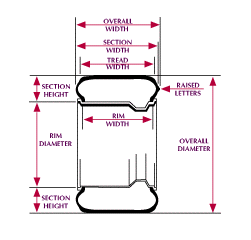
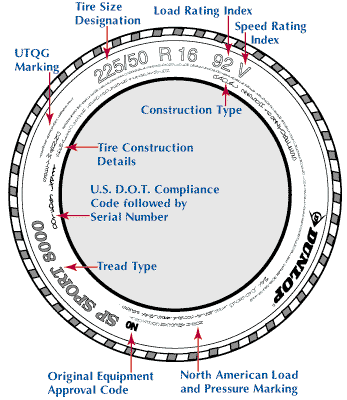
Размер шин:
Можно ли использовать другие размеры? Yes, it is possible to fit different size tires. Of course these tires can only differ
so much. As a rule the circumference should be within 2% (plus or minus) of the standard.
Of course the tire should fit within your wheel wells and should have the proper
load-index (at least C with D preferred). This type of tire is called a "Light
Truck" tire. You will also find that some people use the term 8-ply. That is the
number of plies used for building the tire. A 6-ply tire can be used but most people
prefer an 8-ply because these tires have stiffer side-walls and give a more stable ride.
LT tires are more expensive than your standard passenger car tire. On the other hand your
tires do not need be suitable for high speed running (75 mph is not considered high speed
although you may think so in your bus).
When using the standard 5.5J steel rims (they will look superb if you have them sand-blasted and powder coated!) we can use tires up to a width of 215 mm. For the moment we will disregard wider rims. They may give you clearance problems. The following standard sizes are acceptable: 195/75 R14 en 205/70R14. The circumference of these tires is slightly smaller which means that your speedo will indicate the speed as higher than it actually is. Below is an indication of the difference:
Remember that these numbers are nominal values. Tolerances in manufacturing, tire pressure and wear will influence these numbers. For instance, thread-wear can decrease the circumference by up to 5 cm. But you can see that the nominal values conform to the 2% rule and are as such acceptable for use on our buses. Here are some examples of these tires:
Note: Recently Michelin released their Agilis series of Light Tuck tires. These are very well suited to our buses (high Load Index and nice big threads) and are available in all of the above mentioned sizes. I am now running the Agilis 81, 195/75 R14 on my Vanagon and am very pleased with them. Expect to pay between 60 and 80 dollars for a 185 R 14 tire. Wider tires are more expensive (can run up to about $150 per tire). |
||||||||||||||||||||||||
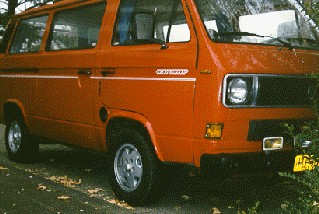
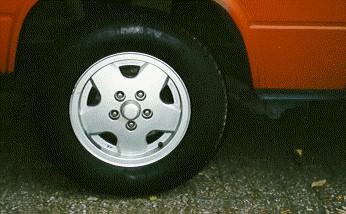
Литые диски: Считается, что литые диски весят меньше стальных. Очень часто это не так. Единственная причина установки литых колесных дисков на наши автобусы это внешность. Насколько я знаю, VW никогда не комплектовал T2 (автобусы Bay-window) литыми колёсными дисками. Однако они были доступны как опция для всех T3 (Vanagons). Эти диски имели размер 6.0J x 14 со смещением (offset) в 30 мм. Размер покрышек для этих дисков был 205/70 R 14. Если у вас есть возможность достать где-то комплект таких дисков, вы должны сделать это без колебаний. Они очень редки и шикарно смотрятся. На снимке мой 81 на этих дисках. На самом деле это не правильно, поскольку этот тип обода появился только с 1985 года.
Если вы хотите литые диски для вашего Bay-window буса, вы можете использовать диски Fuchs, как используется на некоторых Porsche. These are 'period-correct' for a seventies vehicle. However Fuchs rims cannot be mounted without adapters. |
||||||||||||||||||||||||
Part-numbers Standard steel rim T2 / T3 ALLOY RIM 251 601 025 091 Scheibenrad 'ALU', I'd like to credit Brian Verbeek for many of the technical details. |
||||||||||||||||||||||||